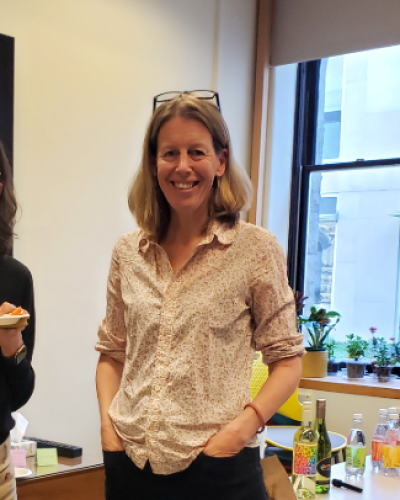
Jocelyn Holland’s paper is part of a larger project whose aim is to explore how material techniques and craftmanship, and the qualities of physical materials, shape language and thought. The paper focuses on metaphors derived from techniques of placement and joining. While common examples such as “dovetailing” do a good job of illustrating how technological practices can be repurposed for metaphorical use, the study ultimately seeks terms with richer conceptual histories. With that in mind, the focus of this paper is the semantically dense German word Fügung, whose evolution reflects complex intellectual developments, especially in the seventeenth and eighteenth centuries. This paper outlines key tendencies in Fügung’s history, introduces an array of sources, and lays the preliminary groundwork for deeper, broader case studies on the relation between of materially based technical practices and their speculative appropriations.
 Department Homepage
The College of Arts & Sciences
Department Homepage
The College of Arts & Sciences
IGCS Colloquium: Jocelyn Holland
More news
View all news